Omniwithdrawals
 Early Payouts
 Crypto Wallets
 Advances
 Express
 vIBAN
vIBAN Music
Music Facebook distribution
 Team Finance
 Webmon
 YouTube Playables
 Viral Music
 Influencer marketing
 Affiliate program
 About Us
 Services
 Security
 Finances
 Careers
 Blog
Blog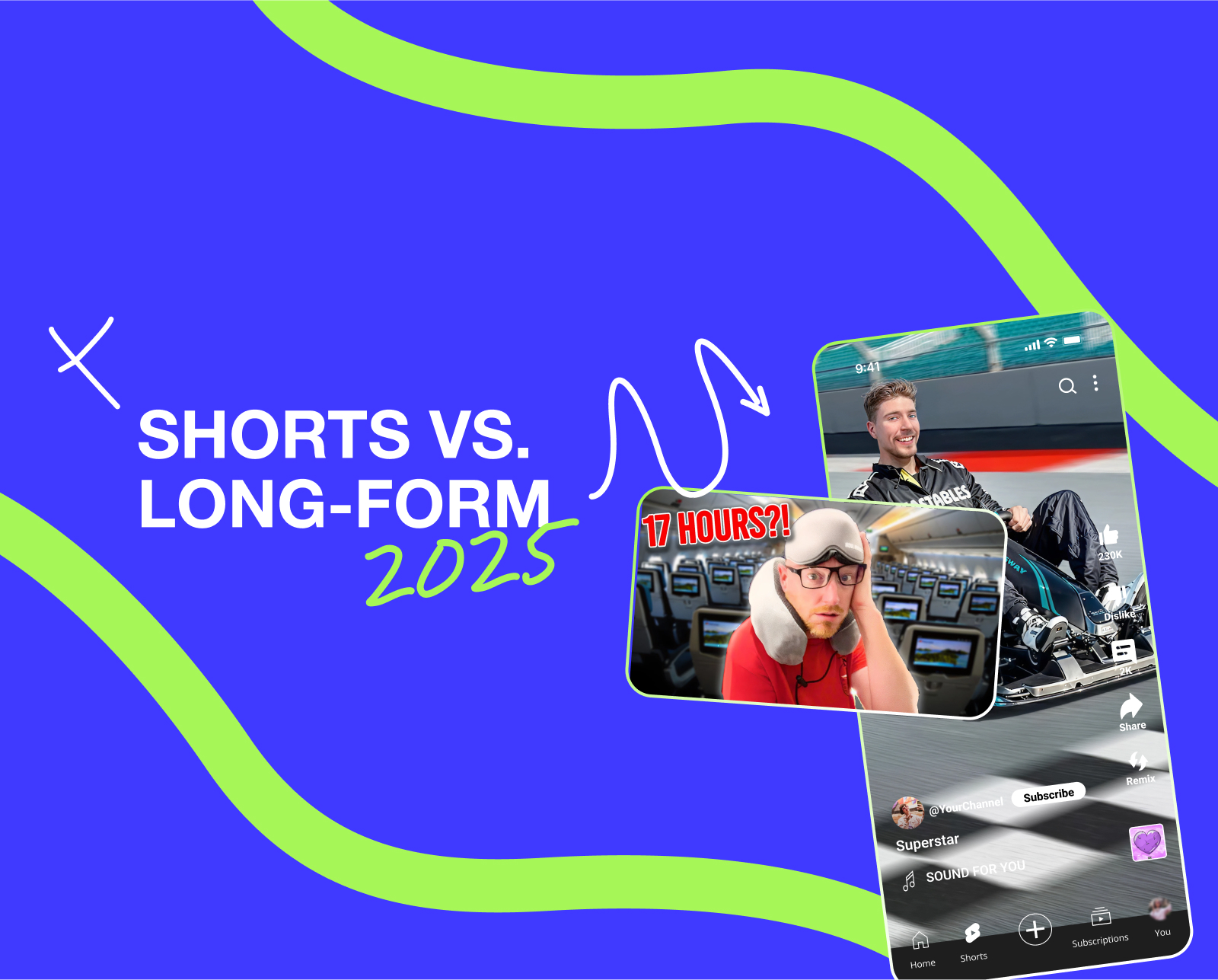
In today’s article, we will certainly examine these issues, explain how the two formats differ fundamentally, and what their advantages are. Overall, we will show you the best ways to work with both formats in practice.
A Brief History of the Emergence of Shorts
We promise there won’t be any boring lectures, but we need you to understand the whole context. By 2020, TikTok started setting the trends. The number of downloads of the app on the App Store and Google Play reached 2 billion, and Google realized that it was time to do something about it.
The platform began developing Shorts. They just needed to figure out how and where to launch it. Help came from an unexpected source: in 2020, TikTok was banned in India, one of the world’s largest markets, and YouTube’s platform quickly stepped in to fill the void. In 2021, Shorts was already operating worldwide, with a $100 million bonus fund: creators were paid between $100 and $10,000 for good performance.
YouTube Shorts vs Long Videos — What’s the Fundamental Difference?
The main difference between Shorts and Long is, obviously, the algorithms. Short videos are designed so that users will react to the first 1-3 seconds of the video and then decide whether to watch it or not. In addition, Shorts are shown one right after another, which allows the algorithm to respond to viewer reactions in real time: whether they watched the video, liked it, shared it, and so on.
The long videos are a completely different story. Here, the so-called “retention depth” is much more valuable — the amount of time a user watches a video. The algorithm is constantly changing, but right now it likes it when users leave likes and subscribe right when they’re watching a video or right after it ends, so don’t forget to remind your viewers to do that.
Why Is Retention Important and How Does It Differ in Shorts vs Long Videos?

First, let’s define what Audience Retention is. AR is a metric that shows how long viewers watch your video.
For example, if your video is 10 minutes long and viewers watch it for an average of 5 minutes, your AR will be 50%.
But if your Shorts lasts 1 minute and users watch it for 55 seconds, the retention rate will be 91%.
This is the main difference between long and short videos for the algorithm. If the system sees that you watch Shorts to the end, it’s a signal that it needs to be moved higher. But in the case of Long-form content, even if the user watches 8 minutes out of 15, that’s still not bad, and the system will recommend it.
That’s why Shorts always have a bright, eye-catching beginning, a concise plot, and a quick conclusion. If a user watches it to the end and shows interest, the system takes note and starts recommending it to others. So don’t be afraid to be bombastic and grab attention from the very first seconds.
In long videos, retention is measured not only by the fact of viewing, but also by the total viewing time. The algorithm wants viewers not just to click on a video, but to spend more time on the channel. This is directly related to building trust and forming a more stable audience.
Statistics and User Feedback
Shorts get over 200 billion views daily (YouTube data for 2024–2025). The average engagement rate is 5.9%, which is higher than TikTok (5.75%) and Reels (5.53%). Short videos provide creators with rapid reach and rapid audience growth, but it is more difficult to retain viewers for long periods of time.
Long-form content, in turn, accounts for more than 70% of total YouTube viewing time, which is not surprising, as the platform remains a place for viewing more in-depth content. The average session duration for long videos is 3–4 times higher, at least because viewers perceive them as more authoritative. And because of this, a creator has the opportunity to build a more loyal audience.
So:
- Shorts are great for quick reach and attention.
- Long-form content ensures deep engagement and builds trust with your audience.
Why are Shorts so popular in 2025?
Two words: mobile consumption. The advent of smartphones has completely changed our world, and in the near future there seems to be no alternative to this kind of interaction with content. Sure, there are experiments with VR, but as you can see, they are still in their infancy.
TikTok has trained users to get a quick dopamine hit and absorb information rapidly, and Shorts works on the same principle, so right now it literally fits the pace of life.
Shorts has done a tremendous amount of work to become a more attractive market participant than TikTok and Reels. And it’s already evident that YouTube is leading the way in terms of engagement. By 2025, Shorts will reach nearly 200 billion views per day, with the number of daily users approaching 2.3 billion, and average engagement already exceeding TikTok and Reels, at 5.9% compared to 5.75% and 5.53%, respectively.
Let’s take a look at some other reasons.
1. Users’ habit of consuming “quick” content
As we discussed above. Users continue to commute to and from school and work and want to somehow “fill” this time. Long content is slightly less suitable for this, especially when it comes to residents of large cities who have to make several transfers along the way. Therefore, content lasting 15-60 seconds is more suitable for this type of consumption.
2. YouTube Algorithms
Trust us, YouTube never stops working on its algorithms. Yes, sometimes this leads to unpredictable results that are not always beneficial to creators, but those who do nothing are never wrong. Either way, Shorts’ live and fast statistics allow the platform to analyze user behavior and preferences and make adjustments to which videos will perform better in search results.
3. Ability to quickly build an audience
Actually, this point could have been put in first place, but we should keep in mind that it has a dual nature. For example, if you make comedy videos and top all kinds of charts, you can quickly gain a certain number of subscribers and fans. But how long can you retain that audience? If you make content about psychology, for example, you can build a certain reputation, but what if you need to dive deep into a topic and only have 60 seconds to do it? That’s why the Shorts format is so controversial: you can quickly gain popularity here, but you’ll still have to maintain it with the “classic” format.
Why Are Long Videos Popular in 2025?
Actually, for the same reason they were popular before. Sure, long-form content offers a ton of opportunities for entertainment, but a huge number of users turn to YouTube for educational content that can hardly be condensed into a few seconds. Long-form content is essentially an indicator of expert content, and viewers value that.
Of course, there are creators who have been able to establish their personal brand through short-form content, but these are literally isolated cases. Creators need to back up their videos with something more than just jokes or quick reactions. Sooner or later, viewers want to get to know the creator better, to “become their friend.”
In addition, the long format is much more predictable and understandable for employers, and therefore more financially advantageous. Marketing specialists prefer to see clear and predictable results, which in the case of Shorts can sometimes be spontaneous. If the creator has been watched for a long time, then there is a certain level of trust in them, so placing their ad in a long format would be strategically more reasonable.
How YouTube Algorithm for Shorts Work
Let’s focus on this point so that you understand the difference between how the algorithm works with long and short videos. Even at a basic level, it is clear that the main difference between these genres is the speed at which users consume content. When watching Shorts, people expect quick thrills and don’t require the creator to delve deeply into the subject matter. Therefore, the first 1-3 seconds of the video are crucial for attracting viewers and encouraging them to watch Shorts until the end. So, how YouTube algorithm for Shorts work?
Of course, the start of a video is important in long videos too, but in them the time interval is slightly longer and stretches to 5-10 and 30 seconds (at least, according to the Mr. Beast team). At the same time, in the Shorts format, you don’t have as much time to grab the viewer’s attention. Therefore, creators of short-form videos will have to pack a powerful hook into just a couple of seconds, which may not be so easy.
Another thing is the video’s theme: of course, if you’re picking up a phone for the first time in your life or just visiting YouTube, the algorithm won’t be able to figure out your preferences, but if you’ve been watching videos about cars, engines, and other moving machines for a while, the platform is more likely to suggest videos about Henry Ford than Elvis Presley.
In any case, the algorithms are designed to focus on the most important metric: retention.
YouTube Shorts monetization pursues the basic principle of internet business: the longer you stay on the website, the more the company earns, and ultimately, it determines the creator’s income.
So, if users watch the video to the end, like it, repost it, leave comments, or rewatch it, the system realizes that the video could become popular, and therefore, it should be shown more often in the feed. In fact, this is the simplest and most straightforward model, which has just been converted into digital format: the best-selling items should occupy the best place on the display.
YouTube Shorts vs Long Videos — What Is the Difference in How the Algorithms Work?
And here comes the main question of our article: what’s the difference between long-form and short-form videos? To understand what content fits you best, you need to figure out how Shorts and regular videos get views.
If the YouTube Shorts algorithm is designed to engage people with content as quickly as possible, then long-form content has a different goal: viewing depth. Here, it is more important whether the video was watched to the end. The algorithm here is structured as follows: if a user has watched a video in its entirety, and especially if they have rewatched or shared it, this is a signal to the algorithm that the content has been well received, it has engaged the viewer, and they wanted to share it. Hence, the objective of Shorts is to elicit a quick response, while the Long-form format requires much more immersion.
That’s why, in the case of long videos, YouTube’s algorithm evaluates not only clicks, but also total viewing time, depth of engagement, and how the content relates to the user’s overall interests. These are the YouTube channel monetization criteria you should always keep in mind.
It is also worth mentioning how Shorts and videos in the “classic” format are distributed. Think about it: if short videos are streamed continuously without interruption, then “long” videos appear based on your recommendations in a “finished” form. Scrolling through the Shorts feed, you may come across completely unexpected videos — this is how the algorithm checks whether you are ready for something new. Meanwhile, standard videos are already tailored to your interests, and you are likely to get exactly what you were looking for before.
Examples of Successful Cases Only With Shorts
Khaby Lame
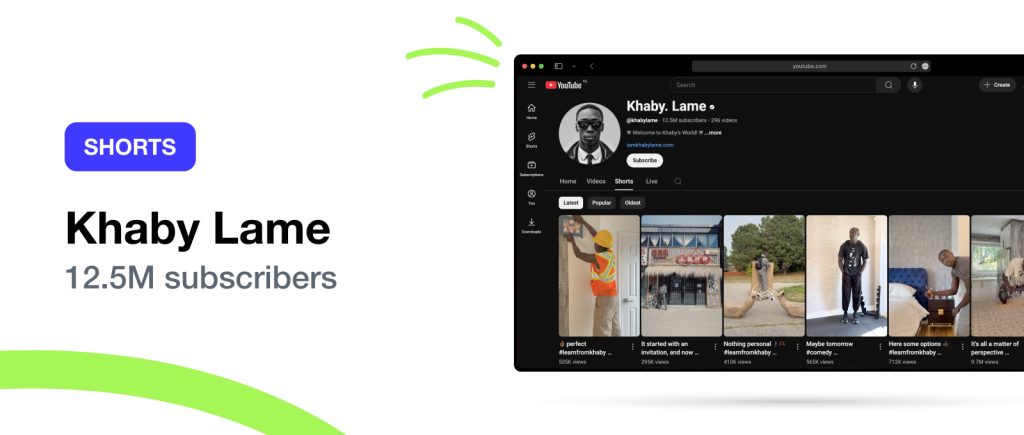
Khaby initially made short-form content his trademark. His sincerity and simple delivery made him a star even before Shorts came along, but here too he succeeded like no other.
Daniel LaBelle
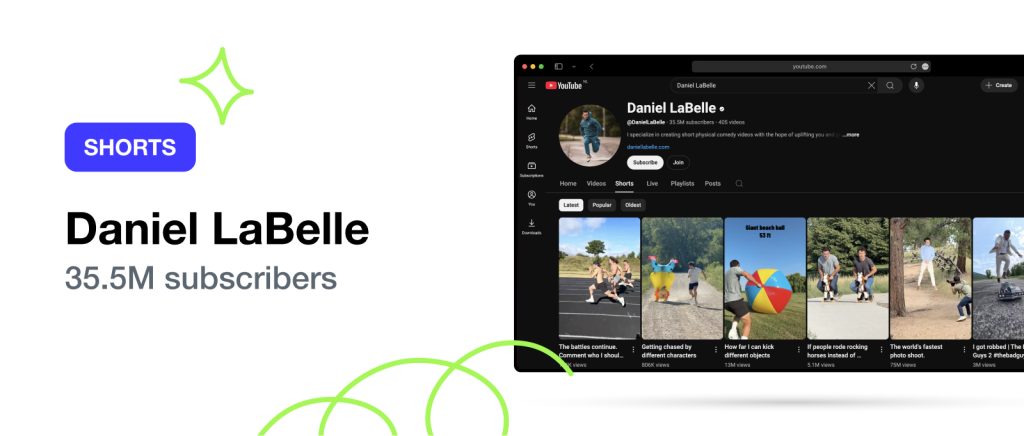
He may not break Usain Bolt’s records, but… who knows? Daniel’s ironic delivery made him a star VERY quickly.
Zach King
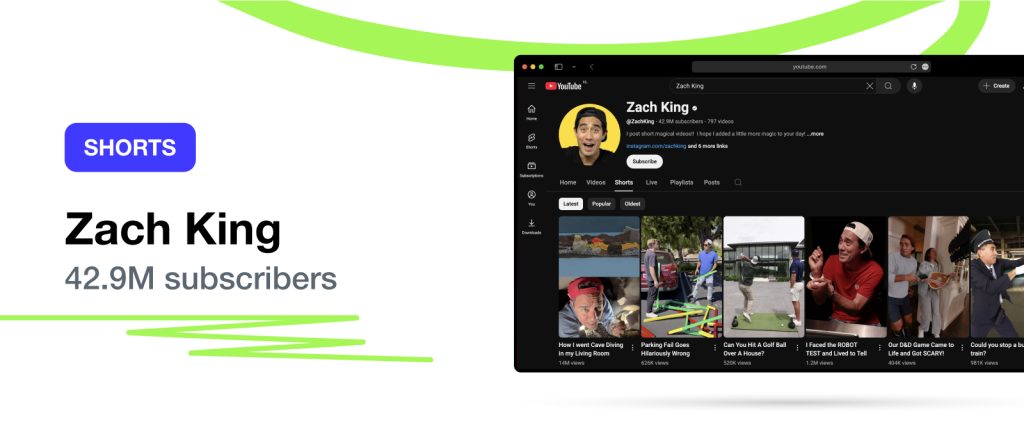
A real classic creator of short videos, who started his career back in the prehistoric days of Vine. If you want a bit of an old-school vibe, he is the successor to the traditions of Oscar winner Zbigniew Rybczyński.
Examples of Successful Cases Only with Long-form Videos
MrBeast
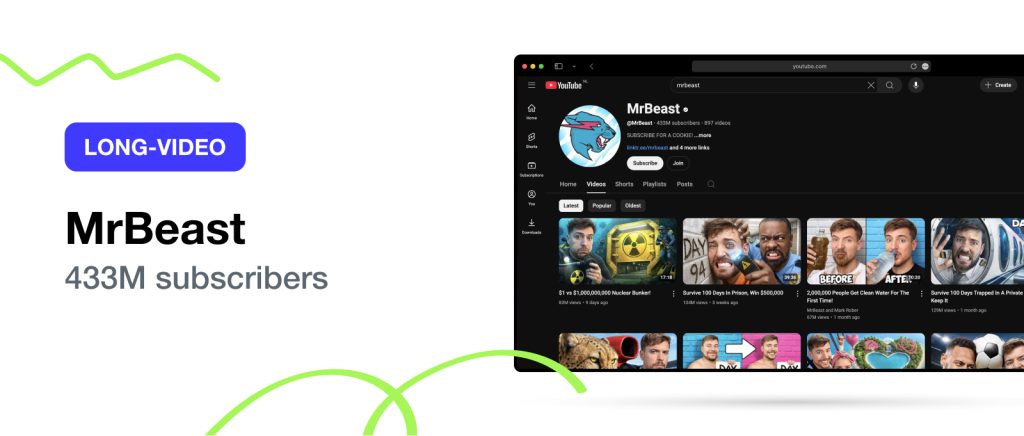
We believe this case speaks for itself. Jimmy showed how perseverance and hard work can lead to global success, and now it’s hard to find anyone on the planet who doesn’t know his name. But he started out by counting to 100,000 on live streams.
Mark Rober
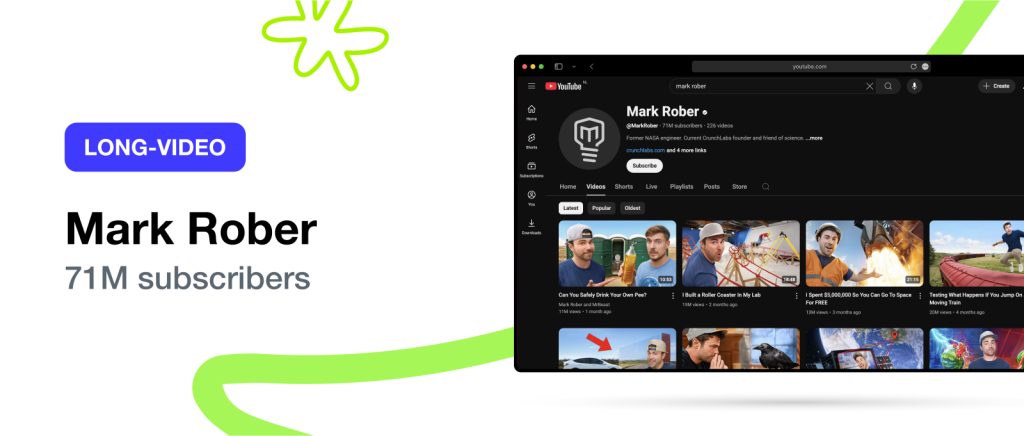
Mark is a former NASA engineer who decided to leave space exploration and focus on showing on YouTube how science works. Water cannons, elephant toothpaste, parcel thief traps —anything you can think of.
Ryan Trahan
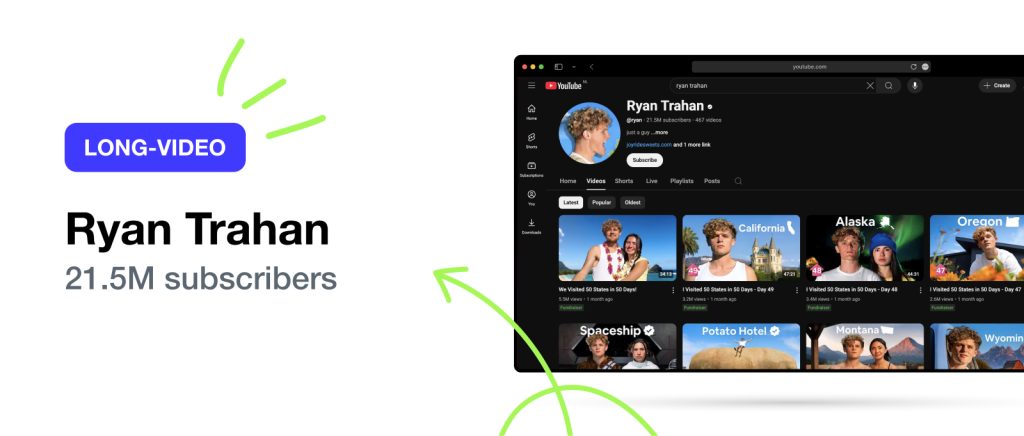
Ryan is great at telling stories, such as “how to survive with 1 cent in your pocket” or “visit all one-star restaurants.” We appreciate him precisely for being so sincere in everything he does.
Why You Should Use Both Formats
YouTube gives you the opportunity to grow and earn money from each of the available options. You don’t have to limit yourself to just one thing: if you feel comfortable creating only short videos, do it for your own enjoyment. But at the same time, this doesn’t limit you from, for example, recording a vlog about how you create these videos, showing behind-the-scenes footage, and even revealing some of your secrets (we’d all love to see how Zach King edits his videos, for example).
Long videos and Shorts are not competitors, but two tools that can complement each other. If long videos help you hold attention and build a relationship with your audience, Shorts are an opportunity to find new viewers. Don’t ever be afraid to take advantage of this opportunity.
Mediacube Prediction About Long and Short Formats
“At present, vertical and horizontal formats on YouTube represent two separate areas with their own audiences and rules for creating and promoting content. They can complement each other, but the overlap between audiences remains limited,” said Alexei Zalozhuk, Head of YouTube Analyst at Mediacube.
“Vertical content is short videos that provide a quick emotional response and instant reach. Horizontal content is a conscious choice by the viewer, allowing the creators to build a personal brand, create long-term value, and build stronger relationships with their audience. If it is easier to attract attention in a vertical format, but the audience ends up being “blurred,” then a horizontal format requires more effort, but in the long run, it yields the most loyal subscribers,” continued one of our senior managers.
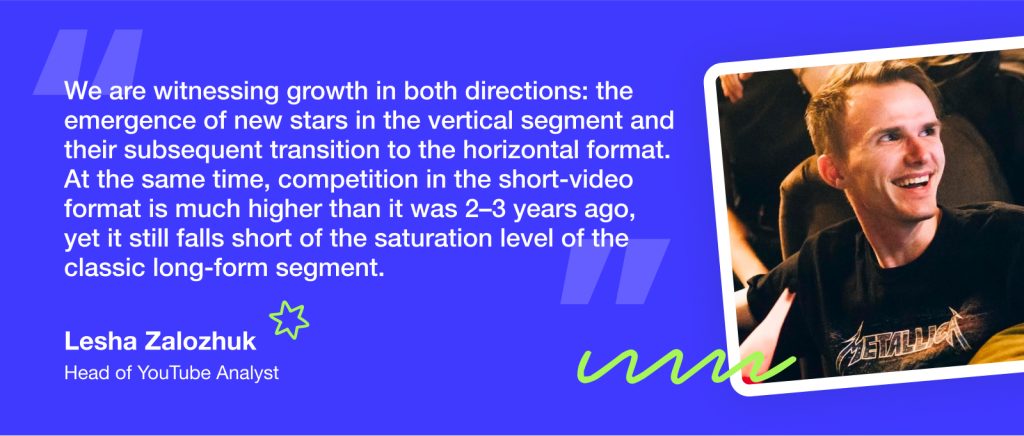
It should be noted that the audiences of these formats hardly overlap. Viewers accustomed to vertical content rarely switch to long videos, whereas audiences accustomed to long formats find it easier to adapt to short clips. This is why it is more difficult for Shorts creators to successfully establish themselves in long-form videos, while creators of traditional horizontal content find it easier to master vertical formats.
And don’t forget that Mediacube experts are always ready to advise you on ways to monetize your YouTube channel so you can earn more.
What Should a Beginner Choose in 2025?
At Mediacube, we believe that this is a highly individual question that depends on both your goals and your resources. YouTube Shorts monetization differs from how long videos are monetized in the same way as it does in the opposite direction. Promotion and engagement methods work differently here, so it is quite difficult to say anything definitive.
Both types of video require various efforts: scriptwriting, production, editing, and so on. Plus, both formats have different viewer retention rates. We believe that the ideal option for a beginner is a combination of both formats. Shorts attract new viewers, provide rapid reach, and provide insight into trends. Long videos help keep viewers engaged and increase the creator’s credibility.
Conclusion
Today, YouTube offers two formats that help creators grow and develop: Shorts and long videos. Shorts are quick, vibrant videos that instantly grab attention and help you find new viewers. Long videos provide an opportunity to immerse the audience in the topic, demonstrate expertise, and build trust. Together, they complement each other perfectly: short videos attract attention, while long ones hold it and allow you to gain the trust of your audience.
Short videos provide reach and new viewers, while long videos help retain them.
There is only one question left: what will you choose?