Omniwithdrawals
 Early Payouts
 Crypto Wallets
 Advances
 Express
 vIBAN
vIBAN Music
Music Facebook distribution
 Team Finance
 Webmon
 YouTube Playables
 Viral Music
 Influencer marketing
 Affiliate program
 About Us
 Services
 Security
 Finances
 Careers
 Blog
Blog
It is also important to keep in mind that YouTube’s demonetization rules are becoming stricter every year. This is especially true for content created using artificial intelligence. What are the YouTube monetization requirements for creators in 2025? What should you do if your video or channel has been demonetized by YouTube? Let’s take a closer look at this issue in our article.
What Does Demonetized Mean?
Demonetization/limited monetization means that you are deprived of the opportunity to earn revenue from your YouTube channel or from a specific video. This occurs primarily due to violations of community guidelines or copyright infringements.
If you go to your Studio account and then to the “Monetization” section, you will see a green dollar sign icon on your videos. If you have violated any of the platform’s rules, the icon will turn yellow as a “warning.” When video monetization is completely disabled, the dollar sign will turn red, as you may have already guessed.
How to Avoid YouTube Demonetization?
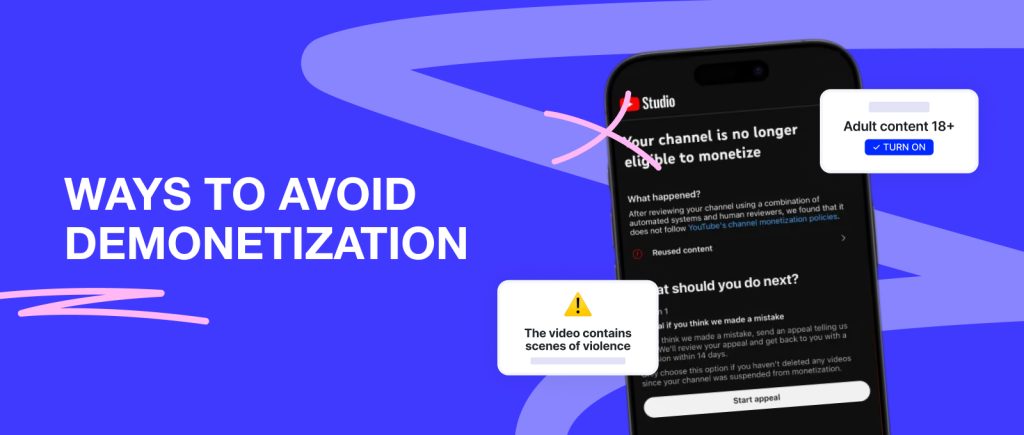
Of course, the simplest answer to this question is to create exclusively original content that does not violate community guidelines. However, we are all aware that in today’s competitive environment, this is very difficult to achieve, and we are forced to use materials that may potentially be subject to platform restrictions. Moreover, many video formats simply cannot function without the use of external materials, no matter how hard you try.
So, to begin with, let’s talk about the topics that are strictly prohibited if you want to avoid YouTube demonetization.
- Inappropriate language
- Violence
- Adult content
- Shocking content
- Harmful or dangerous acts
- Hateful and derogatory content
- Recreational drugs and drug-related content
- Firearms-related content
- Controversial issues
- Sensitive events
- Enabling dishonest behaviour
- Inappropriate content for children and families
- Incendiary and demeaning
- Tobacco-related content
If you avoid these topics, your videos are much less likely to be demonetized by YouTube. However, as you may have noticed, this list includes the item “Controversial topics,” which the platform may use to refer to rather vague concepts. However, these points can be disputed, in particular with the help of Mediacube experts. Plus, we provide all the necessary services and tools for YouTube creators that will help you increase your income.
All YouTube partners are required to comply with the content monetization requirements. These include community guidelines, Terms of Service, copyright requirements, correction rules for settling relations with copyright holders (Creator Music Terms of Service), and AdSense Program Policies.
If you earn income from short videos, you are also required to comply with YouTube Shorts monetization requirements.
Protect Your Content
with Content ID
Get access to YouTube’s Content ID
and expert support from Mediacube to handle
claims, strikes, and copyright issues.
Consequences of Demonetization
In this case, there are several options to consider. Our Support Team Lead Yulia Ostrovskaya explained how YouTube demonetization can affect your income.
- Withholding or adjustment of income. Revenue earned in violation of YouTube’s monetization requirements may be withheld or adjusted. The necessary amounts may also be deducted from your current AdSense balance or subtracted from your future earnings.
- Limitation of ad revenue. YouTube Partner Program members can earn revenue from advertising if your videos do not fall under the restrictions on content types for monetization.
- Removal from the YouTube Partner Program. If you break the monetization requirements, it might be turned off for all or some of your accounts for a while or forever. You can file an appeal within 21 days, and submit a repeat application 90 days after removal.
What to Do in case of Demonetization?
As we advise in every such case, don’t panic 🙂 First of all, you can always contact Mediacube managers. We know what to do and will definitely help you.
You can also go to your YouTube Studio, under “Monetization,” where you will find details about which rules have been violated on your channel. Then, check the video for compliance with the Monetization Requirements, restrictions on content types for monetization, and community guidelines. If necessary, you will need to modify or delete videos in which violations were detected.
After submitting a repeat application, specialists will review your channel again, which typically takes about a month.
Other reasons for channel demonetization:
- Repetitive content
- Reused content
- Fraudulent Activity
“We always give our full support to partners whose channels have been demonetized: we review the content and advise on the necessary changes, and if the first appeal is rejected, we can request a re-review of the channel through our internal communication channel with YouTube. You need to understand that the final decision still rests with the support team,” Yulia Ostrovskaya, head of Medicaube’s support department, told us.
YouTube Demonetization for Copyright Infringement
Copyright infringement is perhaps one of the most common reasons for YouTube demonetization. There are two types of such complaints.
- Requests to remove videos, also known as Takedowns (a strike is issued for violating the Terms of Service)
- Content ID claims. They refer to a specific video, but not to the channel as a whole.
The YouTube Content ID system automatically scans YouTube for copyrighted content. When it finds a match, it sends a claim on the video. Further actions depend on the Content ID settings specified by the copyright holder. Copyright holders can block, monetize, or monitor videos.
By the way, we talked about how to avoid copyright on YouTube in one of our recent articles, which you should check out. You can also learn how to use the YouTube channel audit checklist correctly to increase your views from one of our articles.
If the claim relates to a fragment of the audio track, you can either delete it or replace the music with a copyright-free song. The copyright holder can set different copyright application parameters for different countries. For example, monetization may be enabled in one region, while blocked or tracked in another when the track is used.
Please note that if your content is flagged, it will remain available for viewing on YouTube even if there is an active claim through Content ID. Typically, copyright holders prefer to track viewing statistics and monetize videos rather than block them.
By the way, in one of our recent articles, we explained the difference between a copyright claim and a strike — you should learn more about this.
How to Dispute a Claim Through Content ID?
First, you should know that the Content ID system itself is only available to official YouTube partners, such as us. Otherwise, the procedure is as follows.
- Filing an appeal
In Studio, go to the Content tab — Video. In the “Restrictions” column, point your cursor at the “Copyright — Details” line. In the section What content infringes copyright, find the relevant claim and click Select actions — Dispute claim.
A video claim can be disputed if there are sufficient grounds, for example, if you own all the necessary rights to the content.
After filing an objection, the applicant must respond within 30 days. If this does not happen, the application will be canceled.
- Filing an appeal
The “File an appeal” option is only available for Content ID claims that block videos. When selecting this option, the initial dispute stage, which gives the applicant 30 days to respond, is skipped, and the process begins immediately with the filing of the appeal. After that, the applicant has seven days to respond, so the decision can be obtained more quickly.
Keep in mind that during the dispute process, the claimant can ask for the video to be taken down at any time because of copyright infringement. If this is done in compliance with all requirements, the video will be removed from YouTube, and the channel will receive a copyright infringement warning, which can only be contested by a counter-notification: being legally prepared for court.
- Counter notification
A counter notification is only submitted in the event of a copyright strike if the creator intends to take legal action. As representatives of the YouTube Partner Program, we do not assist with legal claims and cannot represent the interests of the creator or the platform itself. Therefore, a counter notification should only be sent if you are 100% certain that you are right.
If you are unwilling to dispute the claim, there are a number of other ways to resolve the conflict, such as removing from the video the content subject to the copyright claim.
Demonetization for AI Usage
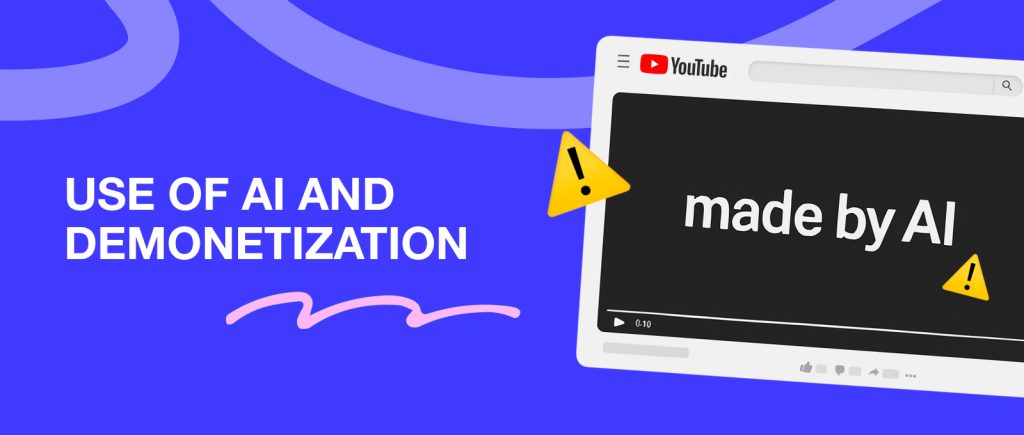
Artificial intelligence has given us a bit of a headache 🙂 On the one hand, AI simplifies many tasks, but on the other hand, YouTube challenges creators to produce original content. So, you should be careful when creating content using generative models.
How does it all look? If a video is created entirely using a neural network and does not demonstrate a clear creative approach, it will most likely result in demonetization. Such videos are classified as “reused content” and are excluded from revenue sharing.
You should be extra careful with deepfake videos, voice modulation of famous people, fake facts, and all kinds of deception. The YouTube algorithm doesn’t get jokes either, so you should be careful here too.
To avoid problems, you should:
- Add personal comments, explain that the content was created using AI, avoid relying solely on generation.
- Remember that AI is only a tool, not a source of original content.
Conclusion
Demonetization is a common practice when working on YouTube. You should think of it more as a process than a punishment. Mediacube experts will always be able to advise you on what to do in contentious situations, especially in cases where you are completely sure that you are right. Be sure to contact us, we will definitely help you 🙂
Good luck and good content!